On filling production lines, two problems are most troublesome for production managers: inaccurate filling and frequent dripping. Inaccurate filling means that the net content of each bottle fluctuates, resulting in losses for either the customer or the company. Frequent dripping means dirty bottle necks, conveyor belts, and the workshop, requiring extra manual cleaning. If you are troubled by these two problems, it's likely not a problem with worker operation, but rather that the equipment itself needs an upgrade.
A typical manifestation of inaccurate filling is that within the same batch of products, some bottles are filled too much, and some are filled too little, with fluctuations exceeding the reasonable range. Many companies, when faced with this situation, immediately think of "having the workers adjust the equipment." However, if it's a pneumatic filling machine, adjustments often rely on manually turning valves and trial filling by feel. Even if it's adjusted well today, the inaccuracy may return tomorrow due to changes in material viscosity. The root cause is that this type of equipment relies on mechanical or pneumatic control, which cannot provide closed-loop adjustment of the filling volume. After upgrading to a servo motor-driven filling system, the situation is completely different: the filling volume is set directly on the touchscreen, and the servo motor precisely controls the piston stroke or flow meter opening based on the set value. Actual filling data for each filling is fed back to the control system via sensors, automatically compensating for any deviations without manual intervention. For example, a condiment factory previously used a pneumatic filling machine for soy sauce, with a filling volume fluctuation of approximately ±5ml per 500ml bottle. After upgrading to a servo piston filling machine, the accuracy improved to within ±1ml, and when changing products, the recipe can be retrieved directly on the screen, completing the switch in minutes. This is not only an improvement in accuracy but also a guarantee of stability.
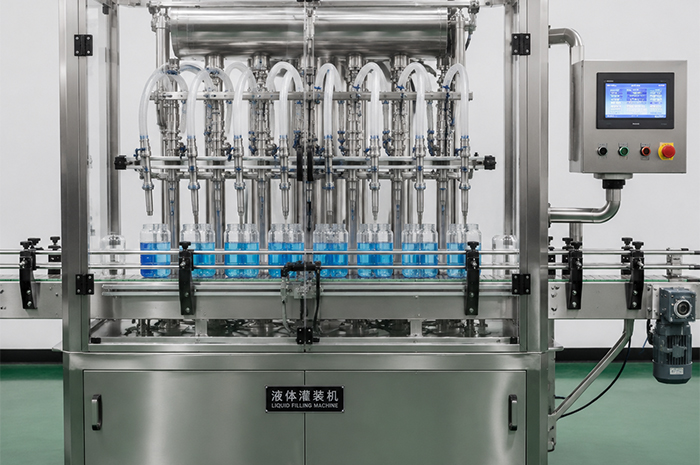
The problem with dripping lies in its chain reaction. Material dripping onto the bottle neck requires manual wiping, increasing labor costs; dripping onto the conveyor belt will be carried to subsequent stages, contaminating the labeling and capping machines, and even causing labels to not adhere properly or caps to slip; dripping onto the floor increases cleaning difficulty and affects the appearance of the workshop. The root cause of dripping is usually a design problem with the filling valve. Traditional filling valves often leave residual material dripping from the nozzle after filling, especially with low-viscosity materials. To solve this, an anti-drip filling valve is needed, such as a back-suction valve. This valve uses negative pressure to draw back the remaining material from the nozzle at the end of filling, completely eliminating dripping. Another solution is a lift-type filling nozzle, which inserts into the bottle mouth during filling and rises before closing the valve afterward, using this positional change to cut off the liquid column and effectively prevent dripping.
Upgrading a filling line typically costs between tens of thousands and hundreds of thousands of yuan. Is this money well spent? Let's do the math. Taking a medium-sized daily chemical company as an example, they previously used pneumatic filling machines, requiring one worker per shift to wipe the bottle necks, resulting in annual labor costs of approximately 30,000 to 40,000 yuan. Material waste and rework losses due to inaccurate filling, calculated based on a daily output of 10,000 bottles and 300 operating days per year, amounted to approximately 20,000 to 30,000 yuan. A more hidden cost is efficiency loss; pneumatic filling machines are slow, limiting output per shift, resulting in less output in the same amount of time. After upgrading to a servo filling machine equipped with an anti-drip valve, the bottle-wiping worker can be eliminated, rework rates are significantly reduced, and filling speed increases by over 30%. Overall, the annual cost savings are typically between 80,000 and 150,000 yuan, and in most cases, the upgrade investment can be recovered within a year.
Inaccurate filling and frequent dripping are not minor production problems, but rather serious issues directly impacting profits and efficiency. If your equipment has been in service for many years and frequently experiences these problems, instead of patching it up, consider upgrading. Upgrading doesn't involve replacing the entire production line; instead, it involves targeted replacement of filling heads, control systems, and filling valve components. The investment is small, and the results are immediate. If you are troubled by inaccurate filling or frequent dripping, please contact us. Henan Mingtan Import & Export Trading Co., Ltd. is a manufacturer specializing in liquid filling machines and production lines. We can provide you with equipment status assessments and upgrade suggestions. Feel free to leave us a message.