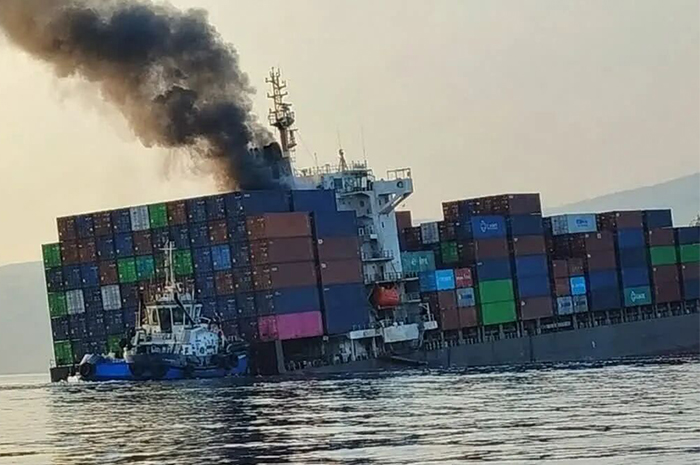
On October 14, an incident occurred in the Strait of Hormuz that demands the attention of any company that has purchased—or is planning to purchase—packaging equipment: a cargo ship carrying approximately 2,500 containers struck a naval mine while transiting the strait, caught fire following an explosion, and subsequently sank. The Islamic Revolutionary Guard Corps of Iran later issued a statement confirming the event.
This is not an isolated occurrence. Since the escalation of tensions between the U.S. and Iran in late February, at least 10 commercial vessels have been attacked in or near the Strait of Hormuz, with two sinking. On October 11 alone, six ships were struck—the highest single-day tally since the conflict began.
Given the immense complexity of responding to such unforeseen crises, how can you minimize potential losses?
First and foremost: You must have insurance—and it must be the *right* kind.
Packaging machinery is no ordinary cargo. A piece of customized packaging equipment—incorporating specialized forming molds, servo-control systems, and production-line integration—can easily be worth hundreds of thousands or even millions of dollars. Because these are not off-the-shelf, standardized components, they cannot simply be replaced with a new unit from a warehouse. More critically, such equipment often serves as the core node of your entire production line; a one-day delay in its arrival disrupts your entire production schedule, while the loss of the equipment at sea could force you to scrap the project and start from scratch.
The premium for a comprehensive marine insurance policy is typically just a small fraction of the cargo's value—perhaps only a few hundred dollars for a piece of equipment worth 200,000. Saving that small amount leaves you exposed to the full financial risk should something go wrong.
However, purchasing insurance is not merely a formality; the specific scope of coverage is what matters.
Standard marine insurance policies often explicitly exclude risks such as acts of war, naval mines, or torpedoes. To secure coverage for these, you must add specific riders, such as "war risk" or "strike risk" insurance. The incident in the Strait of Hormuz falls precisely into this category of specialized risks—specifically, that of naval mines. If this clause is missing from your insurance policy, the insurance company may refuse to pay out if the ship sinks and the cargo is lost.
You should insure your cargo for its full value; do not intentionally under-declare the value to save on premiums. If an incident occurs and the coverage is insufficient, you will end up bearing the remaining loss yourself. Additionally, verify that the risk levels of the destination port and the shipping route fall within the scope of your coverage. Some insurance companies may charge higher premiums or impose restrictions for high-risk regions—these details must be clarified before booking your shipment.
Customized equipment presents a unique challenge: assessing the value of the loss. For standard products, compensation is simply based on market value. But for custom equipment, how is the loss calculated? Is it the cost of individual parts, or the full replacement cost of the entire unit? Elements like molds, software programs, and calibration parameters are one-of-a-kind; such "intangible value" is easily undervalued during the claims process. Confirming the criteria for loss assessment with your insurance company *before* shipment is far more important than arguing over it after an incident occurs.
Point two: Do ??not cut corners on freight costs—doing so compromises your delivery timelines and your credibility.
When comparing quotes, it is all too common to simply tick the "insurance" box and then opt for the cheapest shipping rate. While this logic might hold up on standard, low-risk routes, choosing the cheapest option in high-risk areas is essentially a gamble.
What are you actually sacrificing when you cut freight costs? You might find a direct shipment replaced by one with multiple transshipments—stretching a 25-day transit time to 45 days and throwing your entire production schedule into chaos. You might end up with a smaller, less reputable carrier operating older, poorly maintained vessels on riskier routes. More critically, some low-cost options may involve navigating through high-risk waters, or carriers might take unauthorized "shortcuts" to save time—in the case of the recently sunk vessel, Iranian authorities suggested it was "attempting to pass through an unauthorized and dangerous channel."
How significant is the price difference? For a route to the Middle East, the gap between a standard, reliable shipping option and a "risky" one might only be a few hundred to a couple of thousand US dollars. For a piece of custom packaging equipment worth hundreds of thousands, the freight cost likely accounts for less than 3% of the total value. Exposing an entire shipment to the risks of naval mines and missiles just to save 3% in costs is a losing proposition by any calculation.
A practical question: Can an insurance payout truly resolve everything?
Insurance covers the value of the cargo, but it cannot compensate for the losses incurred when your production line grinds to a halt. If, after waiting 45 days for your equipment, it ends up at the bottom of the sea—and we simply tell you, "The insurance company will pay"—would you be willing to wait another 45 days for a replacement, or would you switch to a different supplier?
Insurance protects your capital, but "saving" on shipping costs could cost you your delivery deadlines and your hard-earned reputation.
While the explosions in the Strait of Hormuz may seem worlds away, your cargo could be much closer to the danger than you realize. As your equipment supplier, we strongly advise the following: ensure your insurance policy covers war and war-like risks, and that the coverage amount is equal to the full value of the goods. Stick to standard shipping routes; do not risk passing through high-danger zones just to cut freight costs. Before shipment, consult with us on how damages would be assessed—ensure that the "intangible value" of custom-engineered equipment is clearly reflected in your policy.
Do not skimp on necessary insurance, and do not deviate from established, safe shipping routes. The freight costs you might "save" cannot recover equipment lost at sea, nor can they fulfill the orders currently waiting on your production line.
Only when your equipment arrives safely is our transaction truly complete. Should you have any questions, please do not hesitate to contact us.If you need packaging machinery or related equipment, leave us a message. We guarantee the quality of our equipment while also providing after-sales transportation and service.